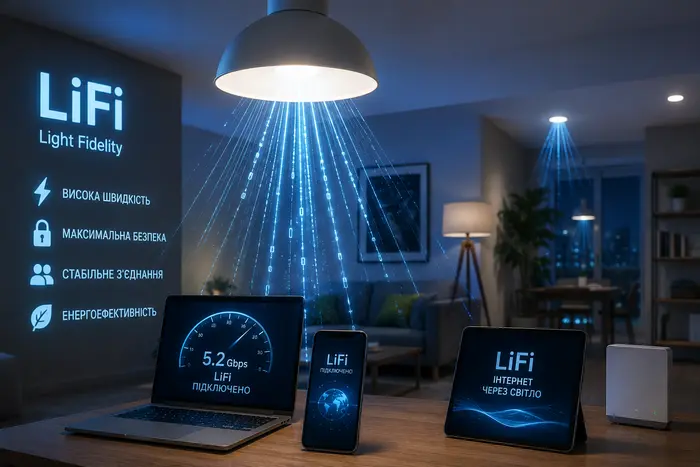
Wireless communication technologies are on the verge of significant changes. Among the latest innovations, LiFi (Light Fidelity) is attracting particular attention—an innovative high-speed data transmission technology that uses light pulses from LED lamps instead of radio waves. It is viewed as a promising addition and, in the future, perhaps even an alternative to conventional Wi-Fi.
How LiFi Works
LiFi works by rapidly flickering LEDs. These pulses are invisible to the human eye, but special sensors in smartphones, laptops, and other devices can easily detect them and convert them into an internet signal. This way, a regular LED light bulb can both illuminate a room and serve as a network access point.
Advantages of LiFi
- High speed: Data transfer speeds via light significantly exceed those of Wi-Fi, making LiFi ideal for 4K/8K streaming, cloud gaming, and fast downloads of large files.
- Security: Since light does not pass through walls, it is virtually impossible to intercept the signal from outside. This makes LiFi attractive for use in banks, government agencies, and other locations with high security requirements.

